Pressotherapy: what it is, how it works and what happens during a session
You've heard of pressotherapy But have you not yet really understood what happens during a session?
Pressotherapy is a treatment that uses a controlled pneumatic compression through special inflatable accessories applied to the body. During treatment, several air chambers swell and deflate according to a programmed sequence, exerting rhythmic pressure on the affected area.
So let’s see what is the pressotherapy, how the machine works, how a session takes place and what sensations you can expect, without miraculous promises and without complicating everything with unnecessary technicalities.
What is pressotherapy, in simple words
The pressotherapy is a treatment based on the application of a controlled pressure through accessories connected to a specific appliance.
The most common application concerns the legs, on which large inflatable leggings are worn. However, there are also sleeves for the arms and other accessories, depending on the device used.
Inside the leggings there are several inner tubes. During treatment, the machine inflates and deflates them according to a pre-established schedule.
This is not a manual massage: The operator does not directly apply hand compressions. It is the air injected into the chambers that exerts pressure on the treated area.
In brief
You wear one or more inflatable accessories connected to a machine. The different chambers fill with air according to a programmed sequence, creating rhythmic compressions on the treated area.
If you want to understand why this treatment is used, you can delve into the benefits of pressotherapy.
How Pressure Therapy Works
The principle behind pressotherapy is relatively simple.
The device sends air inside the different chambers in the leggings or other accessories, generating a pneumatic compression on the treated area.
Pressure is not necessarily applied simultaneously over the entire surface.
The principle of sequential compression: before the abdominal area is prepared
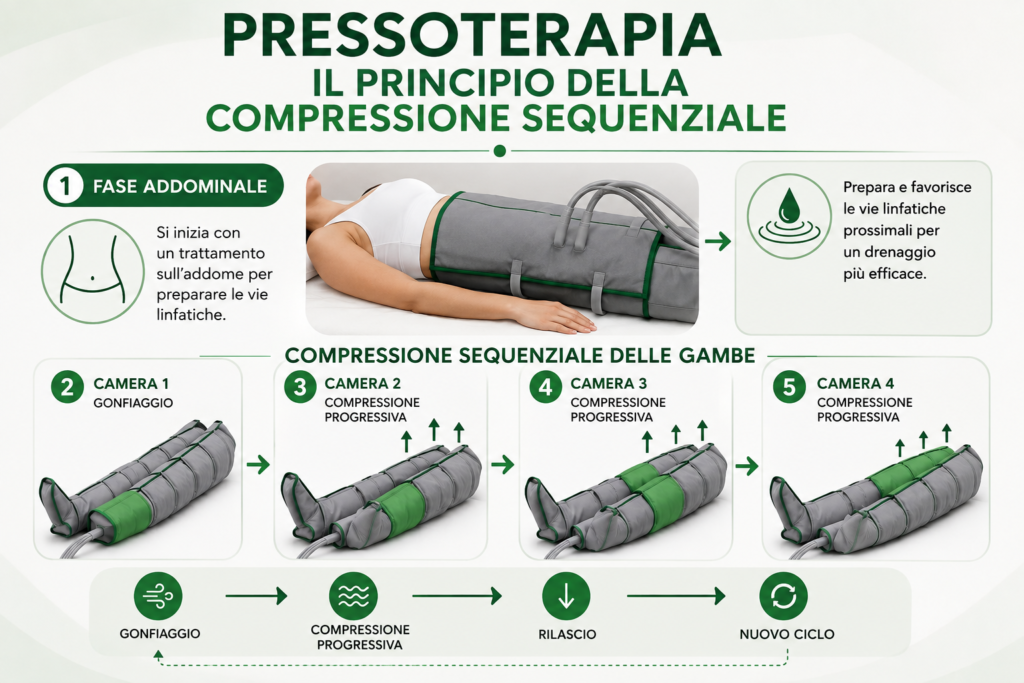
In the drainage-oriented pressure therapy protocol, treatment begins with a first stage on the abdomen.
This phase aims to prepare the main proximal areas involved in lymphatic drainage before proceeding with leg compression. In simple terms, we work first "upstream" and then on the most peripheral areas.
This serves the stimulation of abdominal lymph stations or preparation of drainage routes.
After this initial phase, treatment continues with the leggings.
The inner tubes inflate and deflate according to a programmed sequence, exerting a progressive compression on different parts of the legs.
The treatment can therefore be represented in a simple way as follows:
Abdominal phase → Room 1 → Room 2 → Room 3 → Room 4
preparation of drainage routes → inflation → progressive compression → release → new cycle
Because the pressure is not always the same
The machine allows to manage different treatment parameters.
Intensity, sequence and mode of inflation can change depending on the device used, the program chosen, the area treated and the person.
There is therefore no single correct pressure value for everyone.
And above all, more pressure does not necessarily mean more effectiveness.
Treatment should be set correctly according to the individual’s objective and sensitivity.
To better understand the differences between drainage techniques you can also read the guide dedicated to pressotherapy and lymphatic drainage.
How is the pressure therapy machine made?
A Pressotherapy Machinery It is generally composed of a few easily recognizable elements.
The first is the central unit, from which the processing is set up and controlled.
From the machine there are pipes that transport the air to the accessories applied to the body.
Accessories are internally divided into several inflatable chambers.
For the lower limbs are used especially the classics pressure therapy leggings, which may be reminiscent of large boots. For the arms, sleeves or bracelets can be used instead.
Some devices may also have specific bands or accessories for other areas.
The operation can be summarized as follows:
central unit → tubes → inner tubes → compression on the treated area
It is therefore not mechanical parts that directly massage the body: it is the inflation of the inner tubes that generates the pressure.
How a pressotherapy session takes place, step by step
If you've never tried treatment, probably the most useful question is not just "how does it work?", but:
What actually happens during a pressotherapy session?
Here are the main stages.
1. Before you start
Before the session, some useful information is usually collected to understand the purpose of the treatment and to check the suitability of the person.
The area to be treated is then identified and placed in the intended position, normally on a cot.
Depending on the structure, special arrangements may be required for clothing or the use of hygienic protection under accessories.
However, there is no identical preparation for any device or center.
2. Leggings are applied
In the case of Pressotherapy in the legs, the operator places the leggings around the lower extremities.
At first glance they may look like large padded boots.
The fittings are then connected via the pipes to the central unit and it is checked that they are correctly positioned before starting the programme.
Different accessories may be used for other areas.
3. Inflation and deflation cycles begin
Once the session has started, the inner chambers of the leggings begin to fill with air following the programme set.
The sensation is that of something that progressively tightens around the treated area.
The pressure increases, is maintained according to the characteristics of the program and subsequently decreases.
The various chambers can swell in sequence and the cycle is repeated rhythmically during treatment.
Intensity and mode may vary depending on the device and protocol chosen.
Here, too, an important rule applies: Stronger pressure should not automatically be seen as a synonym for better treatment.
4. The sitting ends
At the end of the program the machine interrupts the cycles.
Accessories deflate and are removed.
The sitting was then closed.
You should not necessarily expect a particular sensation or noticeable result immediately after treatment: this depends on the person, the purpose of the pressotherapy and the chosen path.
One of the most common subsequent questions concerns in fact how many pressotherapy sessions you need.
What do you feel during pressotherapy?
Imagine something tightening around your leg and then gradually loosening your grip.
It's probably the easiest way to describe What you feel during pressotherapy.
The inflation of the chambers generates a rhythmic and perceptible compression.
As the different sections of the accessory can swell sequentially, you may feel that the pressure is moving progressively along the treated area.
However, the experience can change from person to person and depends on the intensity set, the area affected and the individual sensitivity.
The pressure must be perceptible, but this does not mean that it is necessary to endure pain.
If a major nuisance appears during the session, it should be reported to the operator so that he can check the treatment and settings used.
What to expect: Rhythmic pressure, yes. Pain to bear, no.
What is pressotherapy for?
Once you understand how it works, another question naturally arises:
What is pressotherapy for?
Here it is important to distinguish the mechanism of treatment from the reason why it is chosen.
The pressotherapy acts through controlled pneumatic compression.
The objectives for which it can be used are different.
The treatment is frequently associated with the support of drainage and return circulation and is taken into account, depending on the case, in the presence of a feeling of swelling or heaviness, in the management of liquids or for some aesthetic purposes.
There are also specific uses in the health sector, which must of course be evaluated by the competent professionals.
| Application | Reply |
|---|---|
| How does it work? | Through pneumatic compression |
| What can it be oriented on? | Drainage, return circulation and related targets |
| Does it guarantee an aesthetic result? | No, it depends on the objective and the individual case |
We can therefore distinguish three questions:
How does it work?
Through controlled pneumatic compression.
Why does a person decide to do it?
Depends on the objective.
How useful can it be for that specific goal?
It is a later assessment.
For this reason, it is better to avoid simplistic definitions such as ‘lose weight’, ‘eliminate toxins’ or ‘eliminate cellulite’.
Are Pressotherapy and Lymphatic Drainage the Same Thing?
Not exactly.
Pressure therapy uses a pneumatic device and inflatable accessories to exert compression.
The manual lymphatic drainage, on the other hand, is carried out by means of specific manoeuvres carried out manually by a professional.
The two techniques are often named together because they can be associated with drainage purposes, but the way they are performed is different.
It is therefore not correct to automatically consider pressotherapy as a simple ‘machine-made lymphatic drainage’.
Similarly, it cannot be said at all that one technique is always better than the other.
Before trying pressotherapy: an important thing
Understanding how treatment works is important, but so is making sure it's appropriate for your situation.
The pressotherapy It is not automatically indicated for anyone..
The presence of certain medical conditions, vascular or circulatory problems, pregnancy or other relevant situations may require assessment before treatment.
Rather than relying on a short generic list found online, it is preferable to check your situation correctly.
The rule is simple:
first the suitability is checked, then the treatment is chosen.
To assess whether the treatment is suitable for you, consult the information on the pressotherapy service in Florence and Scandicci and request an initial assessment.
In summary: What to expect from pressotherapy
If you have never done pressotherapy, you can imagine a session through four main elements:
- inflatable accessories applied to the area to be treated;
- Sequential Pneumatic Compression generated by inner tubes;
- rhythmic feeling of pressure and release;
- treatment geared towards specific objectives, to be assessed separately from the operation of the machinery.
Now you know concretely What is pressotherapy, how it works and what happens during a session.
The next step is not to ask how many benefits are generally attributed to treatment, but to understand which ones can be really relevant to your goal.
Find out what benefits of pressotherapy might be relevant to your goal